
How To Read Guitar Chord Diagrams
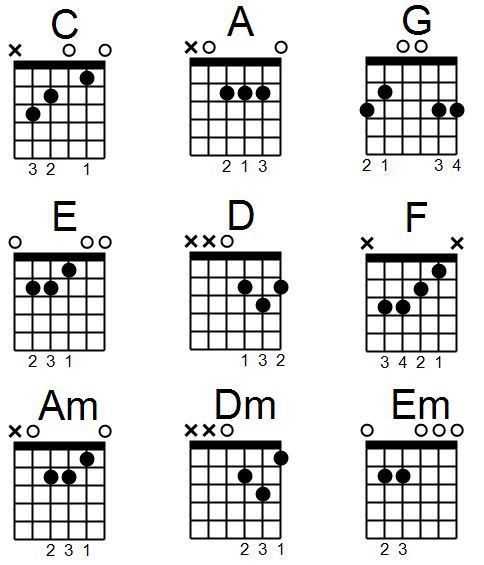
One of the first skills that all guitarists learn is how to read a chord diagram. These diagrams are very helpful when it comes to showing chord shapes and their fingerings. Fortunately for us, it’s also a very easy skill to pick up, and you’ll be reading chord diagrams like a pro by the end of this article.
Before getting into what all those numbers, dots, and letters mean, let’s take a look at a blank diagram and break that down first:
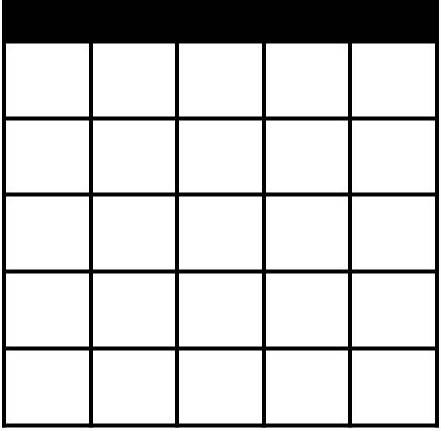
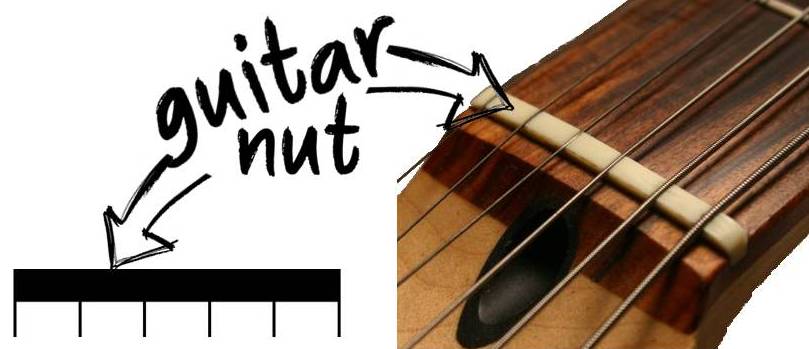
Beginning at the very top, the thick black bar represents the guitar’s nut (the white, sometimes cream colored or black, object at the top of the fretboard on the guitar that elevates the strings over the fretboard):
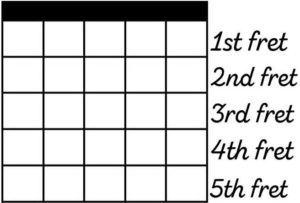
The boxes that follow below the nut represent the different frets. The first row of boxes represent the first fret, second row represents the second fret, and so on.
The vertical lines that run down the diagram represent the six strings on the guitar. The leftmost line represents the sixth string: which is the thickest string, the one that is closest to your head; and the line all the way to the right represents the first string, which is the thinnest string, furthest away from your head.
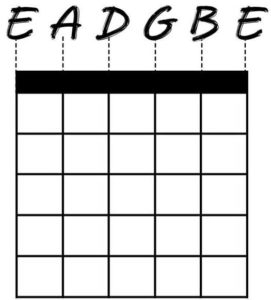
Now that we have gone through a blank diagram, let’s find out what those numbers below the diagram mean.
Finger Numbers
The numbers are telling you which finger you are going to use. The fingers on your left hand are numbered from one through four. Here is what each number represents:
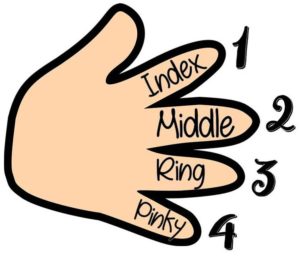
Occasionally, you will see a “T” symbol instead of numbers. In this case, that symbol is telling you to use your thumb to fret that particular note.
What about the dots?
The black dots found on the chord diagrams tell you which fret to press down, and on which string and with which numbered finger. Additionally, you will sometimes see circles above the nut. These circles tell you to play that open string without pressing any fret. So using what we know so far about strings, finger numbers, and dots, let’s check out that same chord diagram again:
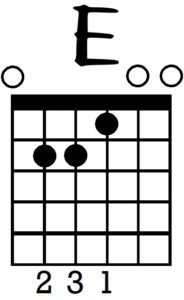
In this diagram, we will place our middle finger on the second fret of the fifth (A) string, ring finger on the second fret of the fourth (D) string, and index finger on the first fret of the third (G) string. Since there are circles above the sixth (E), second (B), and first (E) strings, we will also play those open strings.
What are those letters above the diagram?
If we follow the previous diagram exactly as it is displayed, we will create an E major chord. The large “E” above the diagram simply represents the chord that we are currently playing. These letters can get really complicated, but as a beginner, you will mostly likely be playing basic major and minor chords for awhile.
“X” symbol
Often, you will see X’s above the nut instead of just O’s. These X’s tell you that you should not play that string for the current chord.
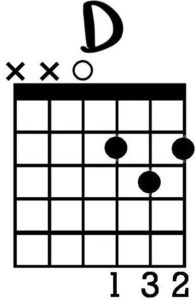
In this diagram, we will only play strings four, three, two, and one. Strings five and six have X’s above them, which means we will mute them, or avoid striking them with our pick (or fingers).
Barre symbol
For those of you who have gotten into playing barre chords already, here’s what a F major barre chord looks like:
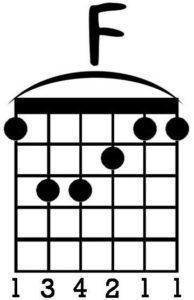
This curved line above the nut is letting you know that you will have to use a barre technique to play this chord. If you’re curious about barre chords, please check out this article.
What about notes above the fifth fret?
As you progress beyond open chords (chords with notes on open strings), you will encounter chords with notes above the fifth fret.
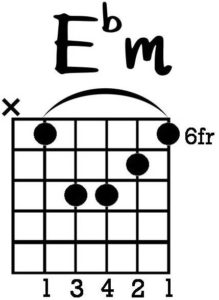
In this Eb minor chord diagram, you will notice a “6fr” symbol to the right of the diagram. This is to tell you that this diagram begins on the sixth fret. Occasionally, you will see symbols like “VI” or just a “6” to let you know that the diagram begins on the sixth fret.
You’re ready to play!
That’s really all there is to it. It’s a very simple and easy to grasp concept that can be understood within five minutes, but in order to remember and master this concept, you will have to practice!
 Tutorial